



An intent-based keyword research strategy focuses on understanding user search intent behind keywords to create highly relevant content. It improves SEO performance, increases organic traffic, and helps businesses match content with informational, navigational, and transactional user needs.
An intent-based keyword research strategy focuses on the “why” behind a user’s search rather than just search volume. By categorizing keywords into informational, navigational, commercial, and transactional intents, marketers can create targeted content that satisfies search algorithms, improves AI visibility, and drives higher conversion rates.
Search engine optimization no longer revolves entirely around keyword density or massive backlink profiles. The focus has shifted drastically toward understanding human behavior. When a user types a query into a search bar, they are trying to solve a specific problem, learn a new fact, or purchase a product. Recognizing and fulfilling that underlying goal is the foundation of modern search visibility.
An intent-based keyword research strategy represents a fundamental shift in how digital marketers approach content creation. Instead of blindly targeting phrases with high search volumes, this approach demands that you analyze the motivation driving the search. By prioritizing relevance and user satisfaction, businesses can attract highly qualified traffic that is much more likely to convert.
This methodology is also critical for surviving the transition toward Generative Engine Optimization (GEO) and AI-driven search experiences. AI overviews and conversational search tools rely on direct, factual answers that clearly address a user’s underlying needs. Implementing an intent-based keyword research strategy ensures your content provides the exact context and clarity these new systems require, securing your visibility across both traditional search engines and emerging AI platforms.
What are the different types of user intent in search?
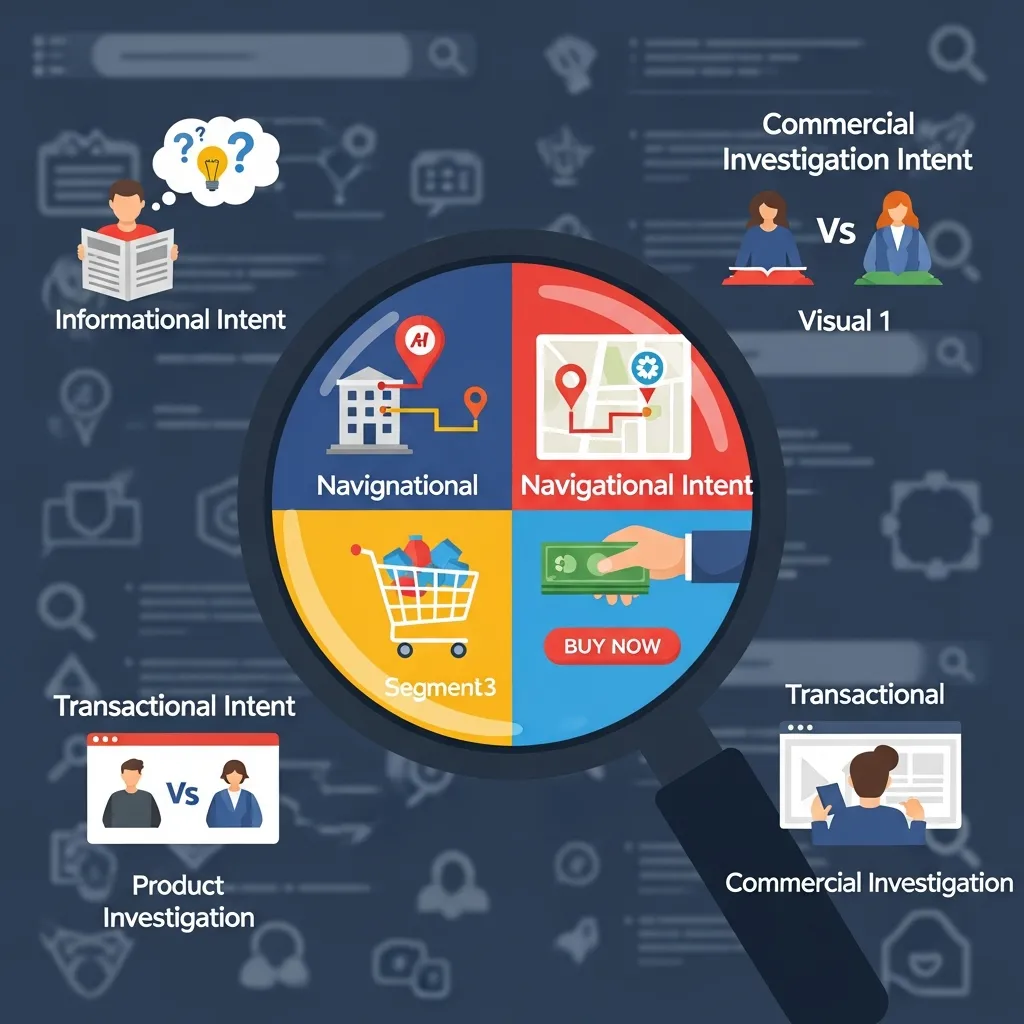 User intent, often referred to as search intent, categorizes the primary objective a person has when they submit a query to a search engine. To execute a successful intent-based keyword research strategy, you must first master the four primary categories of user intent.
Informational Intent
Users with informational intent want to learn something new or solve a specific problem. They ask questions using modifiers like “how to,” “what is,” “guide,” and “tips.” These users are at the very top of the marketing funnel. They are not looking to buy a product immediately; they simply want reliable, educational answers.
Navigational Intent
Navigational queries occur when a user already knows exactly where they want to go, but they use a search engine to get there faster. Examples include searching for “Facebook login,” “YouTube,” or “Apple customer support.” Unless you own the brand being searched, ranking for these terms is incredibly difficult and rarely drives meaningful conversions.
Commercial Investigation Intent
Commercial investigation bridges the gap between learning and buying. Users in this stage know they have a problem and realize they need a product or service to solve it, but they are still weighing their options. They use modifiers like “best,” “top,” “review,” and “vs.” This is a critical stage for content marketers, as users are actively looking for comparisons and recommendations.
Transactional Intent
Transactional queries represent the bottom of the marketing funnel. The user has finished their research, selected a solution, and is ready to spend money. These queries feature strong buying modifiers such as “buy,” “discount,” “price,” “coupon,” or “near me.”
Understanding the differences between these categories is vital. For a deeper dive into how educational and buying queries differ, you can explore the nuances of informational vs transactional keywords SEO to better structure your funnel.
Why is an intent-based keyword research strategy better than traditional methods?
Traditional keyword research treated all search volume equally. Marketers would identify a broad term with 50,000 monthly searches, stuff it into a webpage, and hope for the best. This approach frequently resulted in high bounce rates and terrible user experiences because the content rarely matched what the user actually wanted to find.
An intent-based keyword research strategy focuses entirely on the “why” behind the search. It acknowledges that ranking number one for a high-volume informational keyword will generate very few sales if the user is directed to a transactional product page. When users encounter a page that misaligns with their goals, they leave immediately. Search engines track these quick exits, interpreting them as a sign of poor content quality, which inevitably leads to dropping rankings.
By adopting an intent-based keyword research strategy, you gain a massive competitive edge. You stop wasting budget and resources trying to rank for generic, high-volume terms that do not convert. Instead, you focus your efforts on the specific, targeted queries that align with your business offerings. This approach increases the overall time users spend on your site, improves engagement metrics, and drastically boosts your conversion rates by delivering precisely what the user expects.
How do you implement an intent-based keyword research strategy step-by-step?
 Building a robust intent-based keyword research strategy requires a methodical, data-driven approach. Follow these structured steps to identify, categorize, and target the most valuable keywords for your business.
What tools generate the best initial seed keywords?
The process begins with brainstorming a broad list of seed keywords related to your core products or services. Do not worry about search volume or intent during this initial phase. Focus purely on the language your target audience uses to describe their pain points and desired solutions.
Start by interviewing your sales and customer support teams. They speak directly with your customers daily and understand the exact phrasing buyers use. Additionally, you can review community forums, social media groups, and customer reviews to gather raw, unfiltered seed keywords.
How can marketers analyze SERPs for user intent clues?
Once you have your seed keywords, you must analyze the Search Engine Results Pages (SERPs) to determine how algorithms interpret the intent behind those phrases. Search engines spend billions of dollars perfecting their ability to understand human behavior, so the current top-ranking pages tell you exactly what the user wants to see.
Type your seed keyword into the search bar and evaluate the first page of results. If you see comprehensive blog posts, step-by-step guides, and a “People Also Ask” box, the query has an informational intent. If the SERP is dominated by e-commerce product carousels, shopping ads, and pricing tables, the intent is strictly transactional. Do not attempt to force a blog post into a transactional SERP; the algorithm will ignore it.
Which keyword research tools provide the best intent data?
Modern SEO software has evolved to make intent classification much easier. Leverage comprehensive platforms like Semrush or Ahrefs to expand your seed keyword list while simultaneously gathering intent data.
These tools now feature built-in intent filters. When you enter a broad topic, you can filter the thousands of resulting keyword variations by their specific intent category. This allows you to quickly isolate the highly profitable transactional keywords from the broad informational queries, saving hours of manual SERP analysis.
How do you group keywords by intent and topic clusters?
A disorganized list of keywords is useless. To execute your intent-based keyword research strategy effectively, you must organize your terms into structured categories. Group your keywords first by their overarching topic, and then segment them by their underlying intent.
For example, if your core topic is “email marketing software,” your cluster should be divided into informational queries (“what is email automation”), commercial queries (“best email marketing platforms for small business”), and transactional queries (“buy email marketing software subscription”). Proper grouping ensures you create a comprehensive content ecosystem that supports the user at every stage of their journey. For more specific guidance on aligning these clusters, read about how to match content with user intent.
What is the best way to map user intent to content formats?
The final step of your intent-based keyword research strategy involves mapping your categorized keywords to the appropriate content formats. Different intents require vastly different webpage structures to satisfy the user and the search algorithm.
Informational queries demand long-form blog posts, ultimate guides, video tutorials, and detailed FAQ pages. Commercial investigation queries require comparison charts, detailed product reviews, and listicles. Transactional queries must be mapped directly to highly optimized product pages, pricing pages, and streamlined checkout flows that remove all friction from the purchasing process.
How should you format content for different search intent types?
Executing an intent-based keyword research strategy means writing content that actively solves the user’s immediate problem in the format they prefer.
What are the best strategies for satisfying informational intent?
When targeting informational queries, your primary goal is comprehensive education. You must provide clear, unbiased answers without aggressive sales pitches. Start your content with a direct answer to the user’s question, as this improves your chances of capturing featured snippets and AI overviews.
Use clear headings, bullet points, and short paragraphs to make complex topics easy to digest. According to [Search Engine Journal, 2023], pages that format educational content with clear subheadings and lists experience a 40% higher average time on page compared to dense text blocks.
How can websites optimize for navigational intent?
Optimizing for navigational intent revolves entirely around user experience and site architecture. Ensure your website features a logical hierarchy, a clear navigation menu, and a robust internal search function. Your “About Us,” “Contact,” and main product category pages must be easily accessible from the homepage and clearly indexed by search engines.
Which content formats work best for transactional intent?
Transactional content must eliminate hesitation. When a user searches with transactional intent, they are ready to spend money. Your product and service pages must feature high-resolution images, transparent pricing, clearly stated return policies, and prominent Call-To-Action (CTA) buttons.
Write concise product descriptions that highlight benefits rather than just listing features. Build trust immediately by displaying customer reviews, security badges, and clear shipping information directly near the “Add to Cart” or “Sign Up” buttons.
How do you write content for commercial investigation intent?
Users conducting commercial investigation searches are looking for trusted advisors to help them make a final choice. To satisfy this intent, create side-by-side comparison posts, detailed pros and cons lists, and comprehensive buyer’s guides.
Choose a comparison format if highlighting the differences between two specific products matters more than providing a general overview. Always maintain objectivity in these posts. If you are comparing your product to a competitor’s, acknowledge where the competitor excels while clearly stating the specific use cases where your product is the superior choice.
How does AI improve an intent-based keyword research strategy?
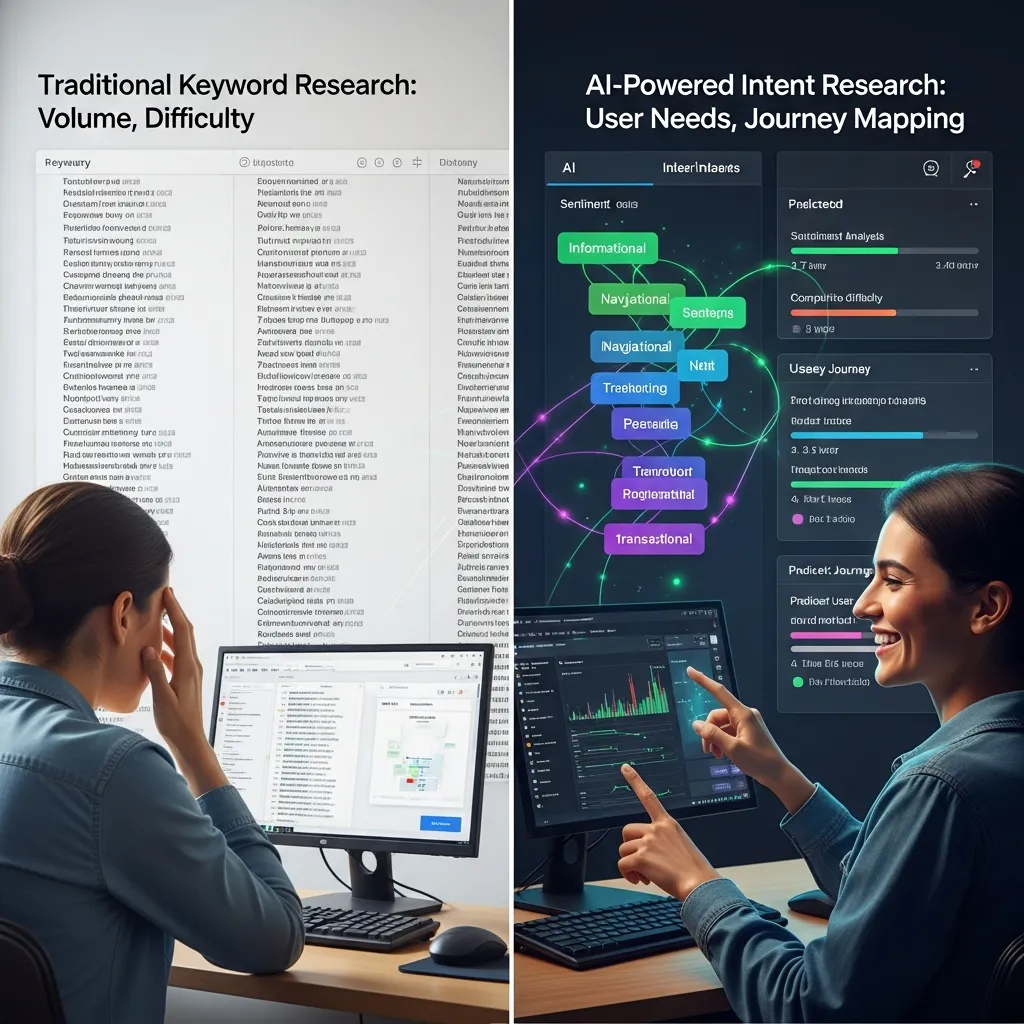 Artificial intelligence is rapidly transforming how marketers execute an intent-based keyword research strategy. AI-powered tools can analyze massive datasets in seconds, identifying subtle patterns in human search behavior that manual analysis would miss.
Platforms utilizing Natural Language Processing (NLP) can automatically classify thousands of keywords by intent with remarkable accuracy. According to [HubSpot, 2024], marketing teams that integrate AI into their keyword research processes reduce their categorization time by over 50%, allowing them to focus heavily on content execution.
Furthermore, an intent-based keyword research strategy is critical for achieving AI visibility. Generative engines like ChatGPT and Google’s AI Overviews construct their answers by pulling fact-dense, highly relevant sentences from authoritative pages. By strictly aligning your content with user intent and providing direct, quotable answers to specific questions, you drastically increase the likelihood that these AI systems will cite your website as a primary source. Ensure you explicitly name all relevant entities—people, products, and concepts—rather than relying on vague pronouns, as this helps AI algorithms build accurate contextual associations.
What KPIs measure the success of an intent-based keyword research strategy?
An effective intent-based keyword research strategy requires continuous monitoring and refinement. You must track specific Key Performance Indicators (KPIs) to ensure your content successfully satisfies the user’s goals.
For informational content, focus on engagement metrics. Track the average time on page, pages per session, and organic backlink acquisition. If a user spends five minutes reading your educational guide, you have successfully met their informational intent.
For transactional and commercial content, prioritize conversion metrics. Monitor the Click-Through Rate (CTR) from the SERPs, form submissions, and direct sales revenue. If a transactional page receives high traffic but generates zero sales, there is likely a disconnect between the search intent and the page experience.
Continually analyze your performance data to identify shifting trends. Search intent is not static; a query that is informational today might become highly transactional during a major industry event. For a deeper understanding of how tracking these specific KPIs influences overall visibility, explore these strategies for improving rankings with user intent.
What advanced tactics strengthen an intent-based keyword research strategy?
Once you have mastered the basics of an intent-based keyword research strategy, you can implement advanced tactics to capture highly qualified niche traffic.
Focus heavily on long-tail keywords. While broad terms like “shoes” are impossible to rank for and feature mixed intent, a long-tail query like “buy red running shoes for flat feet online” carries massive transactional intent. These hyper-specific queries have lower overall search volumes, but their conversion rates are exceptionally high because the user knows exactly what they want.
Additionally, pay close attention to fractured intent. Some SERPs display a mix of informational guides and transactional product pages, indicating that search engines are not entirely sure what the majority of users want. In these scenarios, you can create hybrid pages that offer comprehensive educational content at the top, followed by seamless transactional elements at the bottom. By mastering these advanced nuances, you can consult resources like the search intent optimization guide to refine your approach further. You should also regularly review updates directly from the Google Search Central Blog to ensure your intent mapping aligns with the latest algorithmic updates.
Take the Next Step in Your Search Engine Optimization Journey
 Implementing an intent-based keyword research strategy completely changes how you connect with your target audience. By moving away from arbitrary search volume metrics and focusing entirely on the underlying motivations of your users, you create a digital ecosystem that educates, builds trust, and drives sustainable revenue. Stop guessing what your audience wants. Start analyzing their intent, structuring your content to meet their exact needs, and watch your organic visibility soar.