



Scroll through almost any Google search result today, and you’ll hit a familiar box: “People also ask.” Click one question, and three or four more appear. This feature now shows up in roughly half of all searches, making it one of the most valuable—and most overlooked—pieces of SERP real estate available.
The sites winning these placements aren’t always the biggest brands. They’re the ones that understand how Google populates PAA boxes and structure their content to match. That’s a repeatable skill, not a lucky break. With a deliberate People Also Ask SEO strategy, you can capture multiple positions on a single results page, drive more clicks, and feed your content into voice search and AI-generated answers at the same time.
This guide covers everything you need: how PAA works, how to find the right questions, how to rank in the People Also Ask section, and how to measure your results. By the end, you’ll have a complete framework for Google People Also Ask optimization that you can apply to any page on your site.
What Is People Also Ask and Why Does It Matter for SEO?
 People Also Ask (PAA) is a Google SERP feature that displays a set of related questions connected to a user’s original search. Each question expands to reveal a short answer pulled from a web page, along with a link to the source. Click one question, and Google often generates more—creating a dynamic, almost endless list of related queries.
PAA matters because it occupies prime space, frequently appearing near the top of the results page, sometimes above the first organic listing. Securing a spot here gives your page extra visibility even when you don’t hold the number-one organic position. For sites stuck on page one but below the top three, PAA offers a second path to the visibility you’re missing.
How has People Also Ask evolved in Google Search?
PAA first appeared around 2015 as a small, static box with a handful of questions. Since then, Google has expanded it dramatically. Boxes now load additional questions dynamically as users click, draw from a much wider pool of sources, and appear across a far broader range of query types. The feature has grown from a minor curiosity into a core part of how Google organizes and presents information.
What are the benefits of optimizing for People Also Ask?
A strong People Also Ask SEO strategy delivers several clear advantages:
- Extra SERP visibility: Your page can appear in PAA even when it ranks below the top organic results.
- Multiple placements: A single comprehensive page can answer several PAA questions at once, capturing more space.
- Higher click-through potential: Direct, useful answers earn clicks from users actively seeking information.
- Voice search wins: PAA answers frequently power voice assistant responses.
- AI Overview eligibility: The same structured answers that win PAA boxes often feed AI-generated summaries.
How Does Google Populate People Also Ask Boxes?
Google selects PAA answers using the same broad systems that power its organic rankings and featured snippets. Understanding these mechanics is the foundation of any successful Google People Also Ask optimization effort.
How do Google’s algorithms choose PAA answers?
Google pulls PAA answers from pages it already trusts and ranks well. The algorithm scans indexed content for clear, concise responses that directly match the phrasing of a question. Pages that present a single, definitive answer—rather than burying it in qualifications—are far more likely to be selected. Most PAA sources already rank on page one for related terms, which means strong overall SEO is a prerequisite, not an afterthought.
What role does natural language processing play in PAA?
Natural language processing (NLP) helps Google understand the relationships between questions, concepts, and answers. NLP lets the algorithm recognize that “how do I rank in PAA” and “how to appear in People Also Ask boxes” express the same intent, even with different wording. This means your content doesn’t need to match a question word-for-word. It needs to clearly and completely answer the underlying intent behind the query.
How does user intent shape PAA results?
PAA boxes are built around exploration. When someone searches a topic, Google anticipates the follow-up questions they’re likely to have next and surfaces them in the box. This makes user intent central to your People Also Ask keyword research strategy. To win these spots, you need to map not just the primary question a user asks, but the cluster of related questions that naturally follow.
People Also Ask Keyword Research Strategy
You can’t rank for questions you haven’t identified. A focused People Also Ask keyword research strategy starts with finding the exact questions your audience asks—then prioritizing the ones you can realistically win.
How do you identify PAA opportunities with keyword tools?
Several tools make question research efficient and systematic:
- AlsoAsked: Maps the branching tree of PAA questions around any seed keyword, showing how queries connect.
- AnswerThePublic: Surfaces question-based searches grouped by who, what, when, where, why, and how.
- Semrush and Ahrefs: Filter keyword reports by question modifiers and SERP features to find queries that already trigger PAA boxes.
- Google Search Console: Reveals question-style queries your pages already earn impressions for—prime targets for optimization.
Start with your primary keyword, generate the full set of related questions, and note which ones already display a PAA box in live search results.
Why should you analyze competitor PAA results?
Search your target keyword in an incognito window and study the PAA box that appears. Click through each question and note which domains Google currently pulls from. These are your direct competitors for the spot. Examine how they phrase their answers, how long those answers run, and where the answer sits on the page. This reveals exactly what format Google rewards for that specific question—and gives you a clear target to beat with a tighter, more complete answer.
How do long-tail keywords connect to PAA?
PAA questions are long-tail keywords by nature. They’re specific, conversational, and reflect how real people search. Phrases like “how to rank in People Also Ask section” or “does schema markup help with PAA” carry clear intent and lower competition than broad head terms. Building your content around these long-tail questions aligns your page directly with the queries Google uses to populate PAA. For a deeper framework on matching content to search intent, the intent-based keyword research strategy guide covers the full approach.
How to Rank in the People Also Ask Section
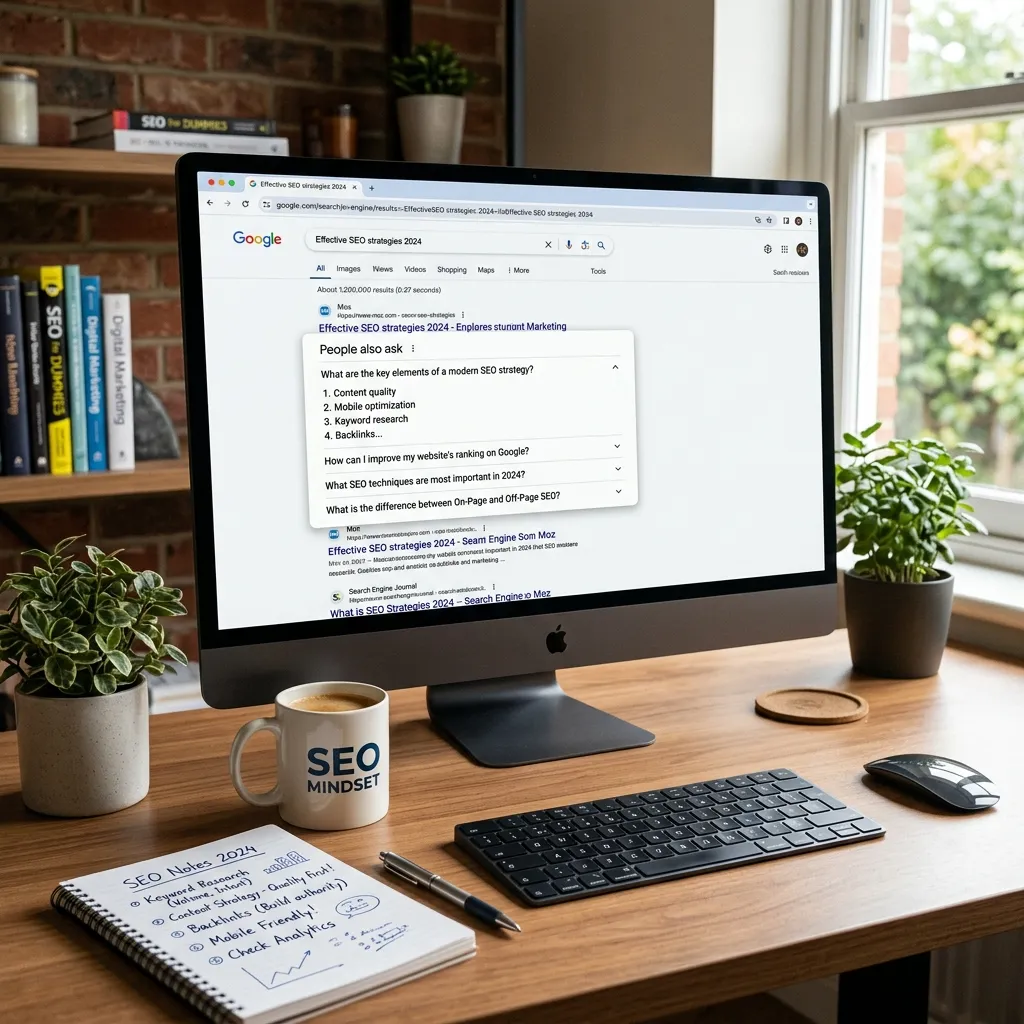 Winning PAA spots is primarily an on-page challenge. The strategies below form the core of how to rank in the People Also Ask section reliably.
How should you structure content to win PAA placements?
Structure is everything for PAA. Identify the questions you want to target and dedicate a clear section to each one. Place the question as a heading, then deliver a direct answer immediately beneath it. Don’t make Google dig for the response—lead with it. Build out additional context afterward for readers who want more depth. This pattern mirrors exactly how PAA boxes display: question on top, concise answer below.
How do you answer questions directly and concisely?
Keep your core answer between 40 and 60 words. Write it as a complete, standalone statement that makes sense even when lifted out of the page. Avoid vague pronouns—name the subject explicitly. Instead of “It helps with rankings,” write “Schema markup helps Google understand your content and improves PAA eligibility.” After the concise answer, you’re free to expand with examples, data, and nuance.
Why do headings and subheadings matter for PAA?
Google frequently pulls PAA content based on heading context. A heading phrased as the exact question a user searches, followed immediately by a clean answer, is the single strongest signal you can send. Vague headings like “More Details” or “Additional Notes” never win PAA spots. Every H2 and H3 on your page should be specific enough to stand alone as a search query—a principle that also strengthens your chances at featured snippets, which share content sources with PAA boxes.
What schema markup supports PAA optimization?
Schema markup is structured data that tells Google exactly what your content represents. For PAA, FAQ schema carries the most weight—it marks up question-and-answer pairs so search engines can identify and surface them more easily. According to Google’s Search Central documentation on structured data, implementing schema helps Google surface your content across more result types, including PAA boxes, featured snippets, and AI Overviews. Schema doesn’t guarantee a placement, but it’s a strong eligibility signal.
How do page speed and mobile-friendliness affect PAA?
Page speed and mobile responsiveness influence your overall ranking, which in turn affects PAA eligibility. Because most PAA sources already rank on page one, a slow or poorly rendered page that can’t reach the top results won’t compete for these spots. Run your priority pages through Google’s PageSpeed Insights, address any Core Web Vitals issues, and confirm every page reads cleanly on mobile. Google indexes the mobile version of your site first, so mobile problems suppress PAA chances directly.
How does internal linking build PAA authority?
Internal links pass authority from your strongest pages to the ones targeting PAA questions. A page sitting at position six with solid internal links flowing to it has a real shot at climbing into the top five—the zone where PAA selection becomes realistic. Use descriptive, keyword-rich anchor text rather than generic phrases. Refreshing and interlinking related content also helps; the content update for SEO ranking boost guide lays out a full framework for keeping these pages competitive. Linking outward to authoritative sources strengthens your E-E-A-T signals too. According to Moz’s Beginner’s Guide to Link Building, editorial links from relevant, credible domains carry the most ranking weight.
Google People Also Ask Optimization Best Practices
Winning PAA spots once is good. Holding them over time requires a repeatable system. These best practices keep your Google People Also Ask optimization effort consistent and durable.
How do you monitor PAA performance?
Google Search Console is your primary tracking tool. Filter your performance data by queries, then look for question-style searches where your page earns impressions. A page appearing for PAA queries but generating low click-through rates may need a sharper title or a more compelling answer. Tools like Semrush’s Position Tracking can monitor specific keywords for SERP feature changes—set weekly alerts so you know immediately when you win or lose a PAA placement.
How should you adapt to algorithm updates?
PAA results shift constantly. Google adds and removes questions dynamically, and a placement you hold today can disappear tomorrow as competitors publish stronger answers. Treat PAA as a moving target. Review your priority pages regularly, refresh answers that have slipped, and study any new questions appearing in your target boxes. The pages that hold PAA spots longest are the ones that get maintained, not the ones published and forgotten.
Why should you build a PAA content calendar?
A content calendar turns PAA optimization from a one-off task into an ongoing discipline. Group related questions into clusters, then plan content that addresses each cluster comprehensively. Schedule regular reviews of your top-performing pages to add newly surfaced PAA questions and update existing answers. This systematic approach ensures you capture new opportunities as Google introduces them, rather than scrambling to react after a competitor moves first.
Advanced People Also Ask SEO Strategies
 Once you’ve mastered the fundamentals, these advanced tactics push your results further and future-proof your approach.
How can you use PAA for content ideation?
PAA boxes are a free, real-time map of what your audience wants to know. Every question Google surfaces represents genuine search demand. Use tools like AlsoAsked to expand a single seed keyword into dozens of related questions, then build comprehensive guides that answer entire clusters at once. This approach not only wins more PAA spots—it produces deeper, more useful content that ranks better overall and signals strong topical authority to Google.
How does PAA connect to voice search SEO?
Voice search and PAA are tightly linked. Voice assistants frequently pull their spoken answers from the same concise, question-based content that wins PAA boxes. The conversational phrasing, direct 40–60 word answers, and clear question headings that power PAA are exactly what voice search rewards. Optimizing for one effectively optimizes for the other, letting a single piece of well-structured content compete across multiple surfaces simultaneously.
What is the future of PAA and AI search?
AI Overviews and generative search are reshaping the SERP, and PAA-optimized content is well positioned for this shift. The structured, fact-dense, question-and-answer format that wins PAA boxes is the same format AI systems extract to build their summaries. As search moves toward conversational, answer-first experiences, content built around clear questions and direct answers becomes more valuable, not less. A strong People Also Ask SEO strategy is, in effect, an investment in AI search visibility.
Common Challenges and Solutions in PAA Optimization
PAA optimization comes with real obstacles. Knowing how to handle them keeps your strategy on track.
How do you deal with dynamic PAA results?
PAA boxes change based on user behavior, location, and search context, which makes them harder to track than static rankings. The solution is to focus on the questions that consistently appear across multiple searches rather than chasing every variation. Track a core set of high-value questions over time and accept that some fluctuation is normal. Comprehensive content that answers a full question cluster is more resilient to these shifts than a page targeting a single query.
How do you avoid keyword cannibalization with PAA?
When multiple pages on your site target the same questions, they compete against each other and split your authority—a problem known as keyword cannibalization. To avoid it, map each question cluster to a single, definitive page. If two existing pages overlap heavily, consolidate them into one comprehensive resource and set up a 301 redirect. The SEO content audit strategy guide explains how to spot and fix cannibalization across your site.
How do you measure the ROI of PAA efforts?
PAA placements don’t always report cleanly in standard rank trackers, which makes ROI harder to pin down. Focus on connected metrics instead: track impressions and click-through rate for question-style queries in Google Search Console, monitor organic traffic to pages you’ve optimized for PAA, and watch engagement signals like time on page. Rising impressions on question queries paired with steady or growing clicks is a reliable indicator that your PAA strategy is working.
Conclusion
A strong People Also Ask SEO strategy is built on understanding real user questions and answering them in a clear, structured, and search-friendly way. By focusing on question-based keywords, concise answers, proper headings, FAQ schema, and strong internal linking, you make it easier for search engines to feature your content in the PAA section.
Start by identifying the questions Google already shows for your target keyword. Then improve your existing pages by adding direct, 40–60 word answers under relevant headings. Finally, use Google Search Console to request indexing and monitor changes in impressions and visibility.
In the end, ranking in People Also Ask is not about guesswork—it’s about consistently delivering better, clearer answers than your competitors.
Frequently Asked Questions
1. What is a People Also Ask SEO strategy?
A People Also Ask SEO strategy is the practice of structuring content to appear in Google’s PAA boxes. It involves identifying question-based keywords, answering each directly in 40–60 words, using question-style headings, and adding FAQ schema so Google can easily extract and display your answers.
2. How do I rank in the People Also Ask section?
To rank in the People Also Ask section, target specific questions your audience searches, place each question as a heading, and answer it concisely right below. Your page should already rank on page one for related terms, since Google pulls most PAA answers from top-ranking content.
3. Does my page need to rank number one to appear in PAA?
No. Unlike the top organic spot, PAA placements often come from pages ranking lower on page one. This makes PAA a valuable second opportunity for visibility when you rank in positions four through ten but can’t crack the top three.
4. How long should a People Also Ask answer be?
Aim for 40 to 60 words. This length matches what Google typically displays in a PAA box. Write the answer as a complete, standalone statement, then expand with additional context and detail in the paragraphs that follow.
5. Does schema markup help with People Also Ask optimization?
Yes. FAQ schema marks up your question-and-answer content so Google can identify and surface it more easily. Schema doesn’t guarantee a PAA placement, but it’s a strong eligibility signal that also supports featured snippets and AI Overviews.
6. What tools are best for People Also Ask keyword research?
AlsoAsked and AnswerThePublic are excellent for mapping question clusters. Semrush and Ahrefs let you filter for question keywords and PAA-triggering queries, while Google Search Console reveals question-style searches your pages already earn impressions for.
7. How is People Also Ask different from a featured snippet?
A featured snippet is a single highlighted answer that appears at the very top of the results. People Also Ask is an expandable box of multiple related questions. Both pull from ranking pages, and content optimized for one often performs well in the other.
8. How long does it take to appear in People Also Ask?
If your page already ranks on page one, you may appear in PAA within two to four weeks of optimizing and re-indexing your content. Pages that first need to climb into the top ten will take longer, since strong rankings are a prerequisite.
9. Can I lose a People Also Ask placement after winning it?
Yes. PAA results are dynamic and re-evaluated constantly. A competitor publishing a stronger answer can displace you, and Google rotates questions in and out of boxes. Regular monitoring and content refreshes help you hold placements over time.
10. How does People Also Ask support AI and voice search visibility?
PAA-optimized content uses the concise, question-and-answer format that voice assistants and AI Overviews extract for their responses. Structuring content around clear questions with direct 40–60 word answers makes a single page eligible across PAA, voice search, and AI-generated summaries.