


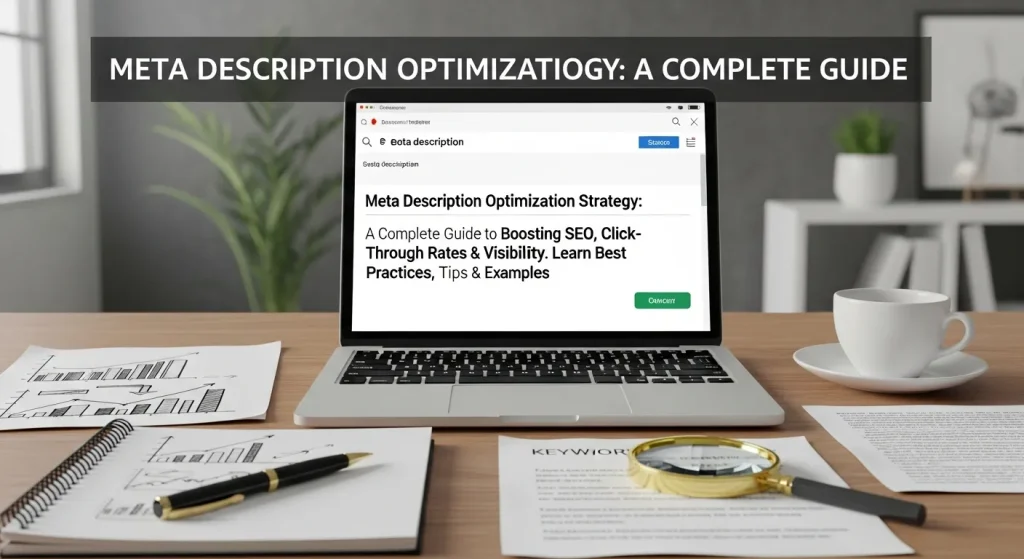
Ranking on page one feels like a win. But here’s the hard truth: a top spot means nothing if nobody clicks. That snippet of text under your blue title? It often decides whether a searcher chooses your page or scrolls past it. A strong meta description optimization strategy bridges the gap between visibility and traffic.
This guide breaks down everything you need to write descriptions that earn clicks. You’ll learn the fundamentals—character limits, keyword placement, and persuasive language—plus advanced tactics like A/B testing and schema markup. We’ll also cover how AI-driven search interprets your descriptions, common mistakes that quietly cost you traffic, and the exact tools you can use to test and improve.
By the end, you’ll have a repeatable framework you can apply to blog posts, product pages, and service pages alike. Let’s get into it.
What is a meta description and why does it matter?
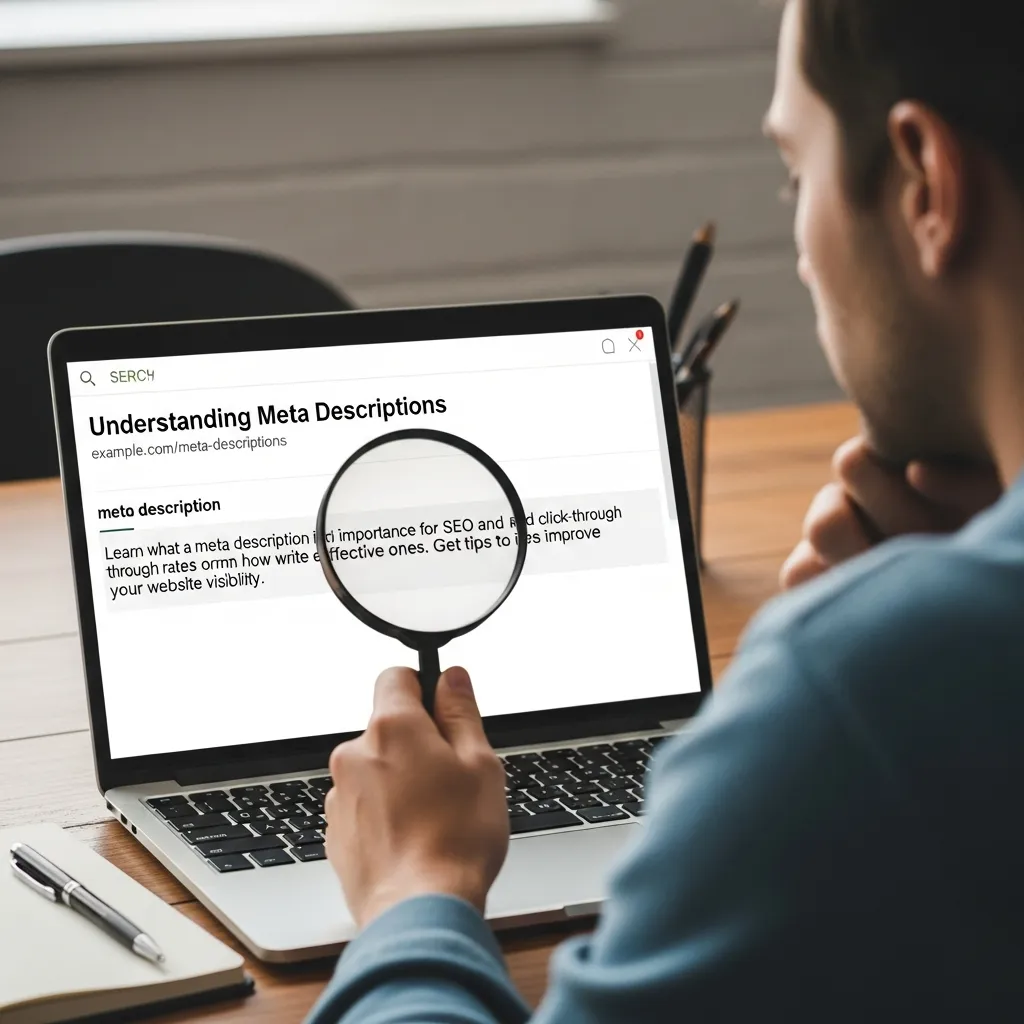 A meta description is the short HTML snippet that summarizes the content of a page. Search engines often display it beneath the title tag in the search results, giving users a preview of what they’ll find before they click.
Why do meta descriptions matter for SEO and CTR?
Meta descriptions do not directly influence ranking algorithms. Google confirmed years ago that the meta description tag is not a ranking factor. So why bother with a meta description optimization strategy at all?
The answer is click-through rate (CTR). A compelling description acts as free ad copy for your page. When two results sit side by side, the one with a clearer, more benefit-driven snippet wins the click. And CTR matters indirectly—a page that consistently earns more clicks than expected for its position sends a positive relevance signal to search engines, which can help sustain rankings over time.
In short, your meta description does not get you ranked, but it does get you visited. For more on this connection, our guide on 7 proven strategies to increase Google CTR digs deeper into the traffic-and-clicks relationship.
What role do meta descriptions play in AI-driven search?
AI Overviews, ChatGPT, and conversational search tools scan pages for clear, self-contained summaries they can pull into answers. A well-written meta description gives these systems a concise, fact-dense snapshot of your page. While AI engines read full content too, a clean description reinforces the page’s core topic and improves the odds your content gets surfaced or cited. Treat your meta description as a signal to both humans and machines.
What are the fundamentals of a winning meta description strategy?
Before you reach for advanced tactics, nail the basics. A solid meta description optimization strategy rests on four pillars: length, keywords, language, and intent.
What is the optimal meta description length?
Keep meta descriptions between 150 and 160 characters. Google truncates anything longer, often cutting off your most persuasive words mid-sentence. On mobile, the visible space shrinks even further, so front-load your most important message.
Aim for one or two tight sentences. According to Moz, descriptions are most reliable when they stay around 155 characters, since this displays fully across the vast majority of devices and search layouts.
How do you incorporate your focus keyword naturally?
Include your primary keyword once, early in the description. When a user’s search term matches text in your snippet, Google often bolds it—a visual cue that pulls the eye and signals relevance.
The key word here is natural. Forcing a keyword into awkward phrasing hurts readability and trust. Write for the human first, then confirm your keyword fits comfortably. If your focus keyword is “meta description optimization strategy,” weave it into a sentence a real person would read, not a string of robotic terms.
How do you write compelling and actionable language?
A meta description is a 155-character pitch. Make every word work. Use these proven elements:
- Lead with the benefit. Tell the reader what they’ll gain, not just what the page contains.
- Add a call to action. Phrases like “Learn how,” “Discover,” or “Get the checklist” nudge users toward clicking.
- Use active voice. “Boost your CTR” beats “CTR can be boosted.”
- Create mild curiosity. Tease a specific insight without giving everything away.
How does user intent shape your meta descriptions?
Match the description to why someone is searching. A user looking up “how to write meta descriptions” wants education, so promise a clear guide. A user searching “best SEO tools to buy” is closer to a purchase, so highlight value, pricing, or a free trial.
Misreading intent is one of the fastest ways to lose a click. To sharpen this skill, study our search intent optimization guide, which maps the right content—and the right snippet—to each stage of the buyer journey.
What advanced meta description optimization techniques work best?
 Once the fundamentals are second nature, these advanced techniques give your snippets a competitive edge.
How do dynamic meta descriptions and personalization work?
For large sites—think e-commerce stores with thousands of products—writing unique descriptions by hand is impractical. Dynamic meta descriptions use templates that auto-fill with product names, categories, prices, or locations.
A template like “Buy [Product Name] online — free shipping and [X]% off this week” scales across thousands of pages while keeping each snippet relevant. Just review samples regularly to ensure the output reads naturally and never produces broken or duplicate text.
How do you A/B test meta descriptions for better performance?
You cannot assume your first draft is your best. A/B testing reveals what your audience actually responds to.
Use Google Search Console to find pages that rank well but earn a low CTR—these are your biggest opportunities. Rewrite the description, change only that one variable, and monitor the results over two to four weeks. If CTR climbs, keep the new version. If it drops, revert or try another angle. This iterative loop is the engine of any serious meta description optimization strategy.
How does schema markup create rich snippets?
Schema markup is structured code that helps search engines understand and enhance your listing. It does not replace your meta description, but it adds eye-catching elements around it—star ratings, prices, FAQs, and breadcrumbs.
These rich snippets make your result physically larger and more trustworthy in the SERP. A listing with five gold stars draws clicks away from plain results, even those ranked higher. Our guide on structured data and schema markup for SEO rankings walks through implementation step by step.
How should you adjust descriptions for different content types?
Different pages call for different approaches:
- Blog posts: Promise a clear takeaway or answer. Lead with the benefit and use an educational tone.
- Product pages: Highlight price, shipping, discounts, or unique selling points. Add a transactional CTA like “Shop now.”
- Service pages: Build trust fast. Mention credentials, results, or a free consultation to reduce hesitation.
How does AI visibility affect your meta description strategy?
AI search has changed how snippets get used—and a forward-looking meta description optimization strategy accounts for it.
How do AI engines interpret and use meta descriptions?
Generative engines construct answers by pulling fact-dense, self-contained sentences from authoritative pages. A clear meta description reinforces what your page is about, helping AI systems classify and cite it correctly. Write descriptions that state the page’s value plainly—avoid vague pronouns and clever wordplay that machines might misread.
How do you optimize for voice search and conversational AI?
Voice queries tend to be longer and phrased as full questions. To align, frame some descriptions to answer a likely spoken question directly. Instead of “SEO tips inside,” try “Learn how to write meta descriptions that boost clicks and rankings.” This conversational phrasing matches how people talk to assistants and AI chatbots.
What future trends should you watch in AI and meta descriptions?
AI tools increasingly generate descriptions automatically. That’s useful for scale, but human review remains essential—generated text can be generic, off-brand, or inaccurate. The winning approach for 2026 and beyond is hybrid: let AI draft, then have a human sharpen the hook, verify the facts, and align the tone with your brand.
What are the most common meta description mistakes?
Even experienced marketers fall into these traps. Avoid them to protect your CTR.
Why are duplicate meta descriptions a problem?
Reusing the same description across multiple pages confuses both users and search engines. When Google detects duplicates, it often ignores them and writes its own snippet instead—stripping your control. Every important page deserves a unique description.
What’s wrong with keyword stuffing?
Cramming a description with repeated keywords reads as spam and erodes trust. It rarely helps and often hurts. One natural keyword placement is plenty.
Why do misleading descriptions backfire?
A snippet that overpromises might win the click, but if the page doesn’t deliver, users bounce immediately. High bounce rates signal poor content quality to search engines and damage long-term performance. Honesty converts better than hype.
What happens when you forget to optimize?
Leave the description blank, and Google auto-generates one—usually pulling a random sentence that may not sell your page at all. Every page that matters should have a deliberate, written description.
How do you implement your meta description optimization strategy?
Knowledge is useless without execution. Here’s how to put it all into practice.
Which tools help with meta description analysis?
Several tools make the job easier:
- Google Search Console — track impressions, clicks, and CTR for every page.
- Yoast SEO or Rank Math (WordPress) — preview snippets and flag length issues as you write.
- Screaming Frog — crawl your whole site to find missing or duplicate descriptions fast.
- Ahrefs or Semrush — benchmark competitor snippets and spot opportunities.
What’s the step-by-step process for creating and testing descriptions?
Follow this repeatable workflow:
- Audit your site. Use a crawler to list pages with missing, duplicate, or truncated descriptions.
- Prioritize by value. Start with high-traffic and high-conversion pages.
- Write a unique description. Lead with the benefit, place your keyword naturally, and add a CTA—all within 155 characters.
- Match the intent. Confirm the snippet aligns with why people search for that page.
- Publish and wait. Give search engines time to recrawl and index the change.
- Measure in Search Console. Compare CTR before and after over several weeks.
- Refine and repeat. Keep winners, rewrite losers.
How does meta description optimization fit your overall SEO strategy?
Meta descriptions are one piece of a larger system. They work hand in hand with strong title tags, clean URLs, intent-matched content, and technical health. Optimizing descriptions in isolation gives modest gains; combining them with a full on-page approach multiplies the impact. Think of your meta description optimization strategy as the final, conversion-focused layer on top of solid SEO foundations.
Turning rankings into real traffic
 A meta description optimization strategy is one of the highest-leverage, lowest-effort wins in SEO. You don’t need new backlinks or fresh content—just smarter snippets that make your existing rankings work harder.
Start small. Open Google Search Console, find your three highest-ranking pages with weak CTR, and rewrite their descriptions using the principles above. Lead with a benefit, place your keyword naturally, add a CTA, and stay under 160 characters. Measure the results in a few weeks, then expand the process across your site.
Better snippets mean more clicks. More clicks mean more traffic, more conversions, and stronger signals to both search engines and AI tools. Make the rewrite today—your rankings are already waiting to be clicked.